Friday, 18 July 2014

Incredible Map Shows Airplanes Getting The Heck Out Of Ukranian Airspace

On a normal travel day, the airspace over Ukraine is some of the most congested in the world. It serves as a major cross roads for flights connecting major hubs in Europe with megacities in Asia. However, after Malaysia Airlines Flight MH17 was reportedly shot down earlier today, most of the world's major airlines have ordered their planes to avoid the area completely. The above map, which was tweeted by Newsweek, shows Ukranian airspace a few hours after MH17 lost contact with radar. Two of Europe's largest airlines, Lufthansa and British Airways, have both told Business Insider that they have ordered their planes away from the disputed region. To avoid the Russian-Ukraine conflict altogether, Lufthansa has specifically ordered their planes to take a southerly route over Romania.

Thursday, 17 July 2014

Airbus's folding saddle seat could be the cattle-class future for cheap flights

Airbus's folding saddle seat could be the cattle-class future for cheap flights As Airbus files a patent for a new space-saving design to jam many more economy class passengers in.

If you thought low-cost air travel couldn't get any more bleak, then Airbus has a treat in store for you. The aeroplane manufacturer has now filed patent for the what looks like a human battery-farm, but is in fact the future of budget flights: racks upon racks of folding saddle-seats for even more passengers to be jammed onto aeroplanes, packed in knee-to-rump.

While some airlines have already removed their folding tray tables and squeezed leg-room down to brutal knee-capping levels, Airbus have gone one step further, doing away with the idea of proper seating altogether. In their ultra-economy vision, seating aisles will instead take the form of long horizontal poles, from which bicycle-like saddles and small back and arm rests will pivot out, on to which humans will be placed, skewered together like table-football players.

“The design of the seats has to be optimised so that they present the smallest possible bulk,” says Airbus, explaining that the saddle-style seat has been developed “in order to reduce the distance needed to accommodate the legs of passengers between two rows of seating devices.”

Gas reps detained for defrauding the elderly

THE Guardia Civil have arrested two representatives of a ‘gas company’ who were thieving in people’s houses when they went to make their inspections. The victims, always elderly, would get a phone call a few days before the inspection; during the phone call the representatives would always inquire as to the age of the people in the house. The victims would be informed that two representatives would visit the house to make sure that everything conformed to standards and was safe.

They would charge €356 for this service and, when the victims would go in search of the cash, the reps would follow them to find where they hid their money and then go back later, while their colleague distracted the elderly person, and steal whatever cash they could find. Investigations began when a complaint was made to the Guardia Civil, by an 84-year-old man, who claimed that after a gas inspection he was left €3,000 short - this was money he had been saving in order to buy a hearing aid. Police rapidly identified and arrested the two individuals who made the visits as well as the woman who would make the preliminary phone calls and the appointments. Investigations into the matter are ongoing as the police suspect that there are a lot of victims who have not yet spoken up about the matter. All three are out on bail until their case goes to court.

THE Local Police in Benalmadena are one of the most tech savvy forces on the coast.

They regularly use the social networks to inform the public about crimes ranging from drug dealing to paedophilia and have an open communication policy on their Twitter account (@policia_benalm).   They tend to shy away from using institutional language and communicate in the same manner as the rest of the users of the social networks. #avoid accidents - grab a cab is one of their usual Saturday night reminders to the general public to avoid drink driving.   Benalmadena Local Police opened their Twitter account last year in April principally to send out press notes and official information but they soon realised that the system had enormous possibilities and started to send out messages about cyber bullying and domestic violence, as well as the usual warnings not to drive drunk.   Because they are a local force they can send messages which directly relate to the residents of the municipality on local matters like which roads are fluid, where there may be any problems around the town or if there may be a wave of pick pocketing going on.  

Police headquarters in the town commented that the decision to use the social networking site, which is not used by any of the other Local Police forces in the area - not even in the capital, was not an easy one as there are many ‘trolls’ online who can hack into an account and ruin it.   They decided to take the risk anyway as they thought it would heighten their profile with the public, which it has done, and help them to improve their image of helping the community rather than just handing out parking tickets.   In other Costa del Sol policing news, the Malaga police force are ageing, with no replacements in sight.   Currently, the average age of a local police officer in Malaga is 45.   Malaga Council is said to be concerned about the ageing force as, due to cutbacks, there has been no ‘new blood’ since the recession started.   Although the council is aware of the problem, they have stated that they are not going to do anything about it for the moment as they do not have the budget to remedy the generational handover needed.   The number of police officers on the roster in 2003 was 980, but the force now has only 924 officers. Of these 924, 40 per cent are over the age of 45 and another 130 have had to be given light duties due to physical problems.  

Due to the budget cuts the council has decided to ‘in the short term’ open up another 30 places, the same as they did when a similar problem happened with the fire brigade in 2008.   Francisco de la Torre, mayor of Malaga, has commented that even though experience is a good thing in a police officer, there is a need for a younger generation to take over in order to bring the average age down. He underscored the fact that all police officers over the age of 50 are given light duties unless they can pass a stringent, yearly, physical test.

British family recount moment forest fire forced them to flee Spanish hotel in Costa del Sol

'It was like Pompeii': British family recount moment they were forced to evacuate Spanish holiday apartment as raging forest fire sent hot ash raining down on them Family arrived at resort and were unpacking when they were forced to flee Clarks were alerted when Spanish porter looked up at hillside and swore Hot ash rained down and smoke obliterated the sun Eight-year-old Isla screamed that the family was going to die

THE Costa del Sol hospital has announced that it will be closing three operating rooms in the afternoons in July and four in August.

THE Costa del Sol hospital has announced that it will be closing three operating rooms in the afternoons in July and four in August.   Ana Corredera, spokesperson for the PP health department, commented that the works being done to expand the hospital have also been blocked for more than two years.   Corredera went on to underscore the fact that there would be no reduction in the number of beds available during the summer but that, due to the reduced budget this year, the summer reinforcements, brought in to cover the four-fold increase of the population, would be “minimal.” The PP spokesperson added that, in her party’s opinion, the delays in the expansion were due to bad local government by the PSOE.

Costa Del Nightmares

Costa Del Nightmares (4×60’), which wrapped filming in Spain last week, has been pre-sold in 110 territories, including BBC Global (Africa, Poland, Asia), FX (India), Planet TV (Slovenia), SIC (Portugal), TV Joj (Slovakia), ABS (Philippines) and VTM (Belgium). The show follows Ramsay as he tries to help expat Brits living on the Costa Del Sol to turn around their struggling eateries

MARBELLA taxi drivers have warned the council about the rising growth of the pirate taxi industry and are threatening a strike if something is not done about it.

MARBELLA taxi drivers have warned the council about the rising growth of the pirate taxi industry and are threatening a strike if something is not done about it. More than 150 cars stopped outside the fairgrounds for two hours to protest the situation about the amount of unauthorised vehicles which abound every summer in the town. “There are around 40 private individuals and companies endangering the livelihoods of the 316 legal taxi drivers in Marbella,” commented one driver at the two-hour protest. David Piquer, spokesperson for the taxi association of Marbella commented that this situation repeated itself every summer and the association was now asking for a sit down with the mayor in order to discuss the situation and find a remedy that would work for everybody. “We just want to be listened to and have our petitions taken into account by the council,” added Piquer. The petition, which summarises the association’s concerns along with the licence number plates of the rogue cars and photographs of their drivers, has been handed in to the council. One of the main bones of contention between the taxi association and the council is the Puerto Banus area which, according to one demonstrator, the police know about but have not taken any action on.

REVEALED: Shocking failure to police drink-spiking in Spanish resorts

POLICE in Spain have apparently no official records for the crime of drink-spiking. Hospitals and town halls have also failed to give any indication of the severity of the problem, despite a terrifying 60% increase in sexual attacks in Spanish resorts last year. The shocking revelation comes as assaults from spiking begin to soar, with the summer season now well underway. “It is clearly becoming a bigger issue and particularly in the summer,” said a source at Marbella Town Hall.

Wednesday, 16 July 2014

We cannot see our greatest selves beyond giant shame trees that provides shade for our demons of guilt

 while we sweat in the harshness of the midday sun of our hang-ups, begging to believe we are worthy.

Released Alien from Border Crisis Arrested for Alleged Murder, Kidnapping in Texas

An illegal immigrant who was released by U.S. authorities with a Notice to Appear has been arrested for the alleged murder of a woman and kidnapping of children on U.S. soil. The alleged crimes occurred after the man was released. The man, Pedro Alberto Monterroso-Navas, entered the U.S. illegally with children and turned himself in to U.S. Border Patrol agents. He was processed and released, as are all illegal immigrants who come as unaccompanied minors or incomplete family units from Central America. The alien is from Honduras. The arrest was first reported by the Associated Press (AP), but Breitbart Texas has exclusively confirmed that the man was part of the Obama Administration’s catch and release policy for family groups from Central America. A U.S. Border Patrol source who spoke with Breitbart Texas on the condition of anonymity provided Breitbart Texas with the alien registration number for the man, and the event number for the man’s apprehension. He was processed in the McAllen station of the U.S. Border Patrol. The alien’s registration number is 202027386. The event number for his apprehension is MCS14061487. The “MCS” designates the McAllen station, the “1406” designates that the man was apprehended in June of 2014. A separate Border Patrol source confirmed that the man was apprehended on June 26, 2014 with two children he claimed were his own. He told U.S. authorities he had family in Metairie, Louisiana.

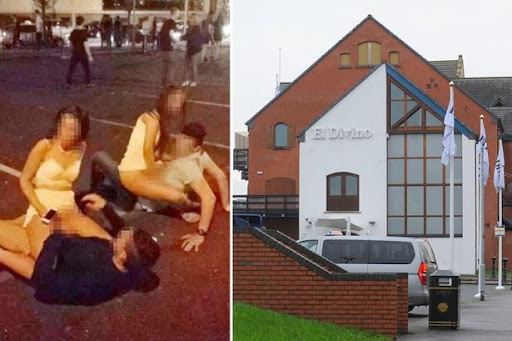
Shocking images showing two couples having sex outside nightclub sparks outrage online

This is the shocking photograph showing two couples having sex outside a nightclub. Two scantily clad girls are pictured sitting on boys’ laps in a car park outside Ed Divino in Belfast as other stunned revellers looked on. The jaw-dropping snap of the two couples, taken last Thursday, has gone viral with people posting their disgust online. One twitter post reads: “WTF is wrong with the young ones did they not learn after magaluf girl n slanegirl now another pic pops up :(.” Another posted: “People have no shame. This is traumatic.”

El Divino nightclub, Belfast: Picture of clubbers having sex in car park posted on Twitter, Instagram and Facebook sparks outrage

A picture of two female clubbers appearing to have sex with two men in a car park outside a nightclub has sparked outrage online. The image has been shared on thousands of social media accounts after being taken outside El Divino in Belfast after a student night last Thursday. It shows the two scantily-clad women on top of the men, with other revellers milling in the background, in scenes reminiscent of the recent video of a clubber giving oral sex to men in return for a drink in Magaluf.

British cyber-jihadist Babar Ahmad jailed in US

A British cyber-jihadist has been sentenced in a US court to 12-and-a-half years' imprisonment after admitting terrorism offences. Babar Ahmad, of Tooting, south London, had admitted conspiracy and providing material to support the Taliban. Ahmad has already spent almost 10 years in prison in the UK and US and his lawyer thinks he could be released in about seven-and-a-half months. He waived his right to an appeal as part of a plea agreement. The judge said she had to weigh the seriousness of the crime with Ahmad's good character, after reading thousands of letters of support and hearing from British prison officials who described him as an exemplary prisoner. The court in New Haven, Connecticut, handed down a sentence of 150 months, half of the 25 years the prosecution was seeking. Ahmad is expected to carry out the remainder of his sentence in New York's Metropolitan Correctional Center.

Tuesday, 15 July 2014

Libya in shock after Tripoli airport attack

Libyans are stunned after two days of fighting between rival militias leaves the country's main international airport out of action. At least eight people have died in the clashes and 12 planes were damaged. The airport remains in the hands of the Zintan militia which has controlled it since Muammar Gaddafi was ousted. The government has been unable to disarm the numerous armed groups that took part in the 2011 uprising and which have divided the country.

Wednesday, 9 July 2014

What Do The New Airport Security Measures Mean For You?


Travellers are being advised to power up electronic devices in hand luggage as part of new security measures introduced at UK airports.

The move comes as the US stepped up its airport security, although the Department for Transport (DfT) said there was "no change to the UK threat level, which remains at substantial" - the third of five possible threat levels. So what has changed and what will it mean for passengers? What are the new restrictions on charging devices in your hand luggage? Passengers passing through airport security will have to prove their electronic devices are powered up by switching them on.

What gadgets are included? As well as mobile phones and laptops, the DfT guidance includes devices such as electrical shavers, hair-straighteners and cameras or any other camera equipment. No complete list has been provided but the general advice applies anything "with a battery", so other items such as handheld games consoles and e-readers could also be checked. What will happen if my device cannot be switched on? The government guidelines say passengers carrying devices which they cannot switch on "face not being allowed to bring the device onto the aircraft". Passengers would then have to choose between charging the device if possible, leaving it behind (see below) or not getting on their flight. What will happen if I leave an electronic device? Some airlines have outlined ways customers can get their devices back. British Airways said passengers could either keep devices at airports for customers to collect or have them forwarded to another address, at the airline's expense.

Virgin Atlantic has said likewise. EasyJet said it was seeking clarification from the government on the new regulations and had not, so far, issued any specific instructions to passengers. Can I charge my device at the airport? To avoid the risk of missing your flight or having your device taken away, make sure it is fully charged and check that the airport you are travelling from has a charging point. If for any reason you have a device with a flat battery, charging points are available near security in most airports - so if you have enough time before your flight you should be able to charge it up.

Tuesday, 19 February 2013

Bolivia nationalized the company that runs the three largest airports in Bolivia because the government claims the company did not invest in improving the airports.

Servicios de Aeropuertos Bollivianos SA (Sabsa) is a division of Spain's Abertis Infraestructure SA but Sabsa is also partly owned by Aena Aeropuertos SA based in Madrid. Bolivian president Evo Morales said that the privatization of Sabsa in 1997 was equivalent to "robbery" and "looting". He claimed that since that time the company's profits have been exorbitant and investments "ridiculous".


real estate company Reyal Urbis filed for insolvency after failing to renegotiate debt with its creditors.

Spain's property market crash claimed another victim on Tuesday, as real estate company Reyal Urbis filed for insolvency after failing to renegotiate debt with its creditors.


The move takes the property developer, which had 3.6 billion euros ($4.8 billion) of debt at the end of September, closer to becoming Spain's second-largest bankruptcy after Martinsa Fadesa, which defaulted on 7 billion euros of debt in 2008.

Dozens of property companies have collapsed in Spain, where house prices have fallen around 40 percent since their 2007 peak. With the country locked in a deep recession, analysts expect prices to fall further still.

Spain's banks were crippled by the property market bust, eventually requiring the state to agree a European bailout for its lenders of almost 40 billion euros last year. Indebted property firms have asked banks for debt relief but patience is wearing thin among lenders saddled with soured property assets.


Reyal Urbis is 70 percent owned by construction magnate Rafael Santamaria and its creditors include Santander, BBVA, Bankia and Banco Popular.

The company, which valued its property portfolio at 4.2 billion euros in June 2012, said it would continue to operate as permitted by Spanish insolvency laws.

Its insolvency petition now goes to court and its fate will be in the hands of a judge.

Reyal Urbis said Santamaria would remain at the helm of the company and he still hoped Reyal Urbis could reach a deal with its creditors, given "the good will of all negotiating parties".

The company had until Feb. 23 to reach a debt restructuring deal with the banks or file for insolvency. Sources close to the matter told Reuters on Friday that creditors had rejected the company's 3.6-billion-euro proposal.

Trading in the company's shares was suspended on Tuesday, Spain's stock market regulator said. The stock had plunged 99 percent since June 2007 to close at 0.124 euros on Monday.

At the end of 2011, Reyal Urbis owned some 888 finished homes in a country where over a million homes lie empty. The company also had 8 million square metres of land for development and 237,000 square metres of commercial property, including offices, shopping centres, industrial property and hotels.

Tuesday, 22 January 2013

Ms Sandiford to be executed for drug trafficking.

A British grandmother has been sentenced to death by firing squad for smuggling almost 5kg of cocaine into Bali.

Lindsay Sandiford was arrested in May last year after she tried to enter the Indonesian holiday island with illegal drugs worth £1.6 million hidden in her suitcase.

Local prosecutors had called for the 56-year-old housewife to be jailed for 15 years. But today there were gasps in the Bali courtroom when a panel of judges announced Ms Sandiford would be executed for drug trafficking.

As the shock verdict was announced, Ms Sandiford, from Gloucestershire, slumped back in her chair in tears before hiding her face with a brown sarong as she was led out of the courtroom.

Sunday, 16 December 2012

Merry Christmas

Monday, 10 December 2012

Emotional eating is when people use food as a way to deal with feelings instead of to satisfy hunger. We've all been there, finishing a whole bag of chips out of boredom or downing cookie after cookie while cramming for a big test. But when done a lot — especially without realizing it — emotional eating can affect weight, health, and overall well-being.

diets arent the answer emotional eating

Not many of us make the connection between eating and our feelings. But understanding what drives emotional eating can help people take steps to change it.

One of the biggest myths about emotional eating is that it's prompted by negative feelings. Yes, people often turn to food when they're stressed out, lonely, sad, anxious, or bored. But emotional eating can be linked to positive feelings too, like the romance of sharing dessert on Valentine's Day or the celebration of a holiday feast.

Sometimes emotional eating is tied to major life events, like a death or a divorce. More often, though, it's the countless little daily stresses that cause someone to seek comfort or distraction in food.

Emotional eating patterns can be learned: A child who is given candy after a big achievement may grow up using candy as a reward for a job well done. A kid who is given cookies as a way to stop crying may learn to link cookies with comfort.

It's not easy to "unlearn" patterns of emotional eating. But it is possible. And it starts with an awareness of what's going on.

Tuesday, 4 December 2012

ARE YOU ADDICTED TO BUSYNESS ARE YOU A SOCIAL MEDIA ADDICT

ARE YOU ADDICTED TO BUSYNESS ARE YOU A SOCIAL MEDIA ADDICT

You may be lost in the addiction to busyness if…

  • Your usual response to “how are you?” is “so busy”, “crazy busy” or “busy but good”
  • You spend time worrying about how busy you are going to be tomorrow
  • You get angry when your spouse or friends aren’t as busy as you
  • Your busy life keeps you up at night thinking about everything you didn’t get done
  • You make a point of letting people know that you stay at the office after hours
  • You check email several times a day
  • You zone out during conversations thinking about everything you have to do
  • You volunteer for things you don’t care about
  • You spend time complaining about how busy you are
  • You make list after list to make sure you don’t forget anything during your busy day
  • You allocate time each day to clean your desk or organize your stuff
  • You regularly eat in your car
  • You use a phone in the car because “it’s the only time you have to talk”

Saturday, 8 September 2012

Police have several leads in the investigation of the large forest fire that started a week ago.

Suspicions that it was started malicously has possibly strengthened. Sources claim that the fire spread quickly because there was more than one fire. Witnesses stated inter alia, have seen an unidentified jeep coming from a farm between Ojén and Marbella exactly where the fire then got an awesome course. In Marbella, it was announced yesterday that it is now able to restore electricity, water and telephone networks in all affected areas. It is now under the companies just the kind of disruption that is "normal". In areas Elviria Ricmar has repaired water pipes, power lines and 3000 meters telephone and fiber optic cable. It has also been launched several campaigns to restore nature and conduct tree plantings. Biologists say that tree planting may be necessary until next year. The hotel chain Fuerte Hoteles has among other things promised to donate a tree for every hotel guest you have in Marbella. The hotels have also started a fundraiser where guests can help by buying a tree, which will then be planted in the affected area.

Friday, 7 September 2012

experts believe we can actually become "addicted" to stress.

Stress can be physical,And then there’s the kind that’s in our heads — that OMG I’m so overwhelmed right now feeling. While psychological stress has some definite downsides (chronic freak-outs may increase our risk for cancer and other diseases), take a moment to exhale. In moderate amounts, stress can boost our focus, energy, and even our powers of intuition.

Still, in some cases, stress does more than light a productivity-boosting fire under our butts. Both emotional and physical stress activate our central nervous system, causing a “natural high,” says Concordia University neuroscientist and addiction specialist Jim Pfaus. “By activating our arousal and attention systems,” Pfaus says, “stressors can also wake up the neural circuitry underlying wanting and craving — just like drugs do.”

This may be why, experts believe, some of us come to like stress a little too much.

Type A and Type D personalities — or people prone to competitiveness, anxiety, and depression — may be most likely to get a high from stressful situations, says stress management specialist Debbie Mandel. Stress “addicts,” Mandel says, “may also be using endless to-do lists to avoid less-easy-to-itemize problems — feelings of inadequacy, family conflicts, or other unresolved personal issues.”

Some stress junkies have difficulty listening to others, concentrating, and even sleeping because they can’t put tomorrow’s agenda out of their minds, explains Mandel. Others tend to use exaggerated vocabulary — craaazy busy right now, workload’s insane!! And some begin to feel anxious at the mere thought of slowing down their schedule.

But psychologist and addiction researcher Stanton Peele cautions against labeling anyone a stress addict. “Only when that pursuit of stress has a significant negative impact on your life could it qualify as addiction,” he said, adding that many people are able to effectively manage — and in fact thrive under — high stress conditions. (Think: Olympic athletes or President Obama.)

 Study: Stress Shrinks the Brain and Lowers Our Ability to Cope with Adversity

For budding stress “addicts” or for those who just, well, feel overwhelmed, here are some tips to dial down that anxiety:

  • Seek professional help if you’re verging on burnout. (Not only can hashing it out with a therapist take a load off your mind. Some studies suggest it also boosts physical fitness.)
  • Do something creative. Mandel recommends carving out a once-weekly time not to think about tomorrow’s agenda by painting, cooking, writing, dancing, or anything else that’ll take you off the clock temporarily.
  • Take it outside. Numerous studies show spending time in nature improves general well-being, lowers anxiety, stress and depression, and even boosts self-confidence. Especially for women. (As it turns out, most addiction recovery centers offer outdoor-immersion programs.)
  • Calm down quickly. If you really don’t have time for any of the above, these 40 tricks to chill take five minutes or less.

Some of us may seek out stress a bit more excessively than others and struggle to just relax. It takes skill to handle hectic agendas and long lists of responsibilities — without losing sleep or feeling frazzled. So try these tips and try not to freak out.

Worried that you or someone you know seeks out stress a little too much? Think stress addiction is a myth? Tell us about it in the comments section below.


For those red wine drinkers who’ve been feeling morally superior about all the health benefits of the relaxing glass or two sipped during dinner, there’s some bad news on the horizon.

 Turns out, those glasses of wine would be a lot healthier if they were non-alcoholic, a new study shows.  Spanish researchers led by Gemma Chiva-Blanch of the University of Barcelona found that non-alcoholic red wine reduced blood pressure in men at high risk for heart disease better than standard red wine or gin, according to the study published in the American Heart Association journal Circulation Research. Although the reduction in both systolic and diastolic blood pressure was modest, decreases of just 4 and 2 mm Hg have been associated with a 14 to 20 percent reduction in heart disease and stroke, the researchers pointed out. “The daily consumption of dealcoholized red wine could be useful for the prevention of low to moderate hypertension,” they concluded.  Although there have been many studies on the impact of moderate drinking on health, the findings have been mixed, with some studies showing a benefit and others suggesting none. The new study found that 3 ounces of gin a day had no impact on blood pressure, while consumption of regular red wine led to a small, but not statistically significant, improvement. The new study suggests that if you’re going to have a drink, red wine would be the healthiest choice, said Dr. Kelly Anne Spratt, a heart disease prevention specialist and a clinical associate professor of medicine at the University of Pennsylvania. Still, Spratt said, “while there are those of us in cardiology who believe in the benefits of red wine, we want to be wary. We’re not going like gangbusters recommending people go out and start drinking. There are a lot of problems associated with drinking, like weight gain, cardiomyopathy, alcoholism, an increased breast cancer risk in women who consume two or more drinks a day.” Chiva-Blanch and her colleagues suspect that blood pressure improvements were due to the impact of polyphenols, a red wine component, on nitric oxide. The theory is that nitric oxide molecules help blood vessels relax, which allows better flow and more blood to reach the heart and other organs. For the new study, Chiva-Blanch and her colleagues followed 67 men with diabetes or three or more cardiovascular risk factors. During the study, the men were all required to consume the same foods along with one of three drinks: 10 ounces of red wine, 10 ounces of non-alcoholic red wine or 3 ounces of gin. During the 12 week study, the men tried each diet/beverage combination for four weeks at a time. The researchers determined that the standard red wine and its nonalcoholic counterpart contained equal amounts of polyphenols, an antioxidant which has been shown to decrease blood pressure. Men who drank regular red wine saw minor reductions in blood pressure – too small, in fact, to be statistically significant. Those who drank gin with their meals saw no change in blood pressure. But men who drank non-alcoholic red wine saw a blood pressure decrease of about 6 mm Hg in systolic and 2 mm Hg in diastolic blood pressure. Chiva-Blanch and her colleagues concluded that their findings show that the alcohol in red wine actually weakens its ability to lower blood pressure.

Thursday, 26 July 2012

Paper Passion, a scent from Geza Schoen for Wallpaper magazine, makes its wearers smell like freshly printed books

Paper Passion, a scent from Geza Schoen for Wallpaper* magazine, makes its wearers smell like freshly printed books. I suppose it can be alternated with "In the Library," a perfume that smells like old books.

Paper Passion fragrance by Geza Schoen, Gerhard Steidl, and Wallpaper* magazine, with packaging by Karl Lagerfeld and Steidl.

“The smell of a freshly printed book is the best smell in the world.” Karl Lagerfeld. 

It comes packaged with inside a hollow carved out of a book with "texts" by "Karl Lagerfeld, Günter Grass, Geza Schoen and Tony Chambers."

Monday, 23 July 2012

It will cost two million € to connect the electricity, and nobody wants to pay.The empty Guadalhorce Hosptial in Cártama

The Guadalhorce Hospital has been completed in Cártama on the Costa del Sol, but it has been empty for several months with no opening date planned.

To continue installing the equipment in the hospital it has to be accepted as meeting requirement, and to show that hospital is as planned, but for that to take place it must be connected to the electricity supply.

The problem is that will cost two million €, although the originally quoted price was 300,000 €, to install the electrical connection required. Endesa say the problem is that to supply the hospital an electrical substation at Villafranca del Guadalhorce will have to be expanded.

Cártama Town Hall has said they cannot meet the extra cost, which has put the budget up five fold. Mayor Jorge Gallardo says he thinks the electricity company is ‘making the most of the circumstances’. 

However the Junta say they think the 2 million bill should be met by the Town Hall. They say the electricity contract was undertaken by Cártama Town Hall.

The Guadalhorce Hospital has been built thanks to an agreement between the Málaga Diputación, the Junta de Andalucía and the Cártama Town Hall, to give the district its long-wanted hospital. Many foreigners live in the inland area and have complained about the time to get to a hospital in Málaga.

Spain wildfires: Three killed


Forest fires in the county of Alt Emporda, in north-east Catalonia, on 22 July 2012Officials say the flames have been fanned by strong winds

Forest fires raging in Spain's north-eastern Catalonia region have left three people dead, officials say.

Two French nationals drowned in the sea close to the border with France while trying to escape the flames, Catalonia's interior minister said.

Strong winds gusting up to 90km/h (55mph) have rendered one fire "out of control", he said.

All residents of the county of Alt Emporda - about 135,000 people - have been ordered to stay indoors.

The area is a main link for holidaymakers travelling to and from southern France. Traffic on the cross-border AP-7 motorway was reported to have been severely disrupted on Sunday.

Cardiac arrest

The two French victims were among several people who were trapped by fire as they travelled along the N-260 main coastal road near the town of Portbou and tried to reach the sea by climbing down cliffs, according to Catalan Interior Minister Felip Puig.

Map

The victims were a 60-year-old man and his 15-year-old daughter, Spanish media reported.

A 75-year-old man died after suffering a cardiac arrest in Llers, north-west of the area's main town, Figueres.

At least another 19 people have been wounded, including a French national who suffered burns on 80% of his body when he was caught in his car by the flames.

The fire near Portbou has been brought under control, according to media reports, while a much larger blaze further inland, around the border town of La Jonquera, was still spreading late on Sunday, Felip Puig said.

The fire, travelling at about 5-6km/h, came within 10km of Figueres, Mr Puig said.

A total of about 13,000 hectares (32,000 acres) of forest are estimated to have been devastated in the area, according to the authorities.

Spain Scraps Siesta as Stores Stay Open to Spur Spending

The Spanish shopping siesta may be about to become the latest victim of the sovereign debt crisis. To stimulate spending after a 23 percent drop in retail sales since 2007, the euro region’s fourth-largest economy this month approved measures that allow shops of more than 300 square meters (3,229 square feet) to open for 25 percent longer a week. The new rules may encourage the outlets to sell during the traditional afternoon snooze from 2 p.m. to 4 p.m., and on an additional two Sundays or holidays a year for a total of 10. “When everything was fine, nobody complained, but now that things have gone awry, then it’s another story,” said Carmen Cardeno, director general for domestic commerce at the nation’s economy ministry, which created the rules. “We need to evolve and be more flexible.” Spain is following its European neighbors in trying to liberalize shopping hours that have traditionally been checked by governments in the region to protect religious observances, for rest and on behalf of smaller retailers that have fewer resources to staff shops around the clock. England has allowed retailers to open for longer on Sundays during the Olympics than the six hours usually allowed. In France, food shops can be open 13 hours a day and stores located in tourist areas have the right to open on Sundays. Spanish shops are allowed to open for less time than anywhere else in Europe, according to its government, which was asked by retail associations to allow large stores to open 16 Sundays or holidays a year. Some smaller merchants opposed the extension, arguing that the bigger stores would have the necessary manpower and they wouldn’t. The new measures allow stores 18 additional business hours a week and will permit merchants to decide when to cut prices in sales instead of only twice a year. Siesta Time The country’s regions will get to decide how to implement the rules, though they usually follow the lead of the central government. In Madrid, which is an exception, stores have been able to open for as long as they want since July 15. Outlets of less than 300 square meters also have no restrictions on opening hours, though the Spanish tradition of eating at home and having a siesta means most shopkeepers keep their businesses closed for about two hours in the middle of the day. The new measures may not be enough to offset shrinking demand in Spain’s 217 billion-euro ($264 billion) retail industry, which is worsening each year the crisis goes on in a nation where one in four people is out of work. The number of companies seeking bankruptcy protection rose 22 percent from a year earlier to 2,224 in the first quarter, according to the nation’s statistics institute, with commerce being the third- largest contributor behind construction and housing firms and industrial and energy companies. ‘Almost Insignificant’ Javier Millan-Astray, director general of retail association ANGED, said the approved loosening of restrictions on opening hours doesn’t go far enough. “The government’s reform is almost insignificant,” Millan-Astray told reporters in Madrid, when retail groups pushed for 16 Sunday openings. The associations’ “new proposal would help boost consumption and create more jobs because when we open on a holiday, people come and shop. It’s unbelievable that amid this crisis, we have to keep our stores closed.” Spain has been wrestling with the dilemma of preserving its culture and modernizing the industry for decades. The socialist government of Jose Luis Rodriguez Zapatero in 2004 rolled back liberalization of opening hours instituted by his predecessor, bringing them back to rules from the 1990s and leaving the country with the tightest regulations of any European country. Job Creation Even with the latest proposals, “retail regulation is hurting both business and customers in Spain,” said Fernando Fernandez, a professor at the IE Business School in Madrid. “Both big and small retailers would benefit from fewer restrictions. When big retailers such as Ikea or Zara open a store, all small shops in that area benefit from that.” Ending the restrictions completely would create 337,581 jobs across all industries and add 17.2 billion euros to economic growth this year, according to a study commissioned by the government, which examined the implications of several scenarios. The nearest of those to the current proposals, under which stores open on 16 Sundays or holidays, could have added 47,945 full-time retail jobs, the study found. About 1.8 million people worked in retail in the first quarter, 0.3 percent less than in the year-earlier period. Stores are also bracing for change as the government looks to the retail industry to help boost tax revenue. Prime Minister Mariano Rajoy will increase the most common rate of sales tax to 21 percent from 18 percent on Sept. 1, putting an additional brake on consumers’ ability to spend. previous

Saturday, 21 July 2012

Spain king ousted as honorary president of World Wildlife Fund branch after elephant hunt

The World Wildlife Fund’s branch in Spain has ousted King Juan Carlos as its honorary president — a title he’d held since 1968 — after deciding his recent elephant hunting safari was incompatible with its goal of conserving endangered species. The announcement Saturday was the latest in a string of bad news for Spain’s royal family, which has been embarrassed by legal and other scandals. The fund said in a statement that “although such hunting is legal and regulated” it had “received many expressions of distress from its members and society in general.” It said members voted at a meeting Saturday in Madrid to “to get rid of the honorary President” by a substantial majority of 226 votes to 13. The Royal Palace declined immediate comment on the announcement. Many Spaniards were dumbfounded when news broke in April that the king had made a secret journey to hunt elephants in Botswana even though it was widely known he was president of the Spanish branch of the fund. Such an opulent indulgence also angered Spaniards at a time when national unemployment hovers around 25 percent, the economy is contracting and there are fears the country may need an international financial bailout. The Spanish public learned of the safari only after the king had to fly back in a private jet to receive emergency medical attention for a broken hip suffered during the trip. In an unprecedented act of royal contrition, a sheepish Juan Carlos apologized, saying as he left the hospital: “I am very sorry. I made a mistake. It won’t happen again.” It was a poignant moment because the royal family had been under intense media scrutiny for all the wrong reasons. The king’s son-in-law, Inaki Urdangarin, is a suspect in a corruption case, accused of having used his position to embezzle several million euros in public contracts through a supposedly not-for-profit foundation he’d set up. Over Easter, the king’s 13-year-old grandson, Felipe Juan Froilan, shot himself in the foot with a shotgun, even though Spanish law dictates you must be 14 to handle a gun. The king on Tuesday decided to take a pay cut in solidarity with civil servants who are to lose their traditional Christmas bonuses as part of the government’s most recent austerity drive. The salaries of Juan Carlos and Crown Prince Felipe will be reduced about 7 percent — to about 272,000 euros ($334,000) and 131,000 euros ($160,000) respectively — in line with government policy, the Royal Palace said. The king and prince acted voluntarily in cutting their salaries, the palace said.

Friday, 20 July 2012

Invasion of the pickpockets

Britain is in the grip of a pickpocketing epidemic as Eastern European gangs descend on London ahead of the Olympic Games.

A surge in sneak street thefts means more than 1,700 people fall victim every day – an increase of nearly a fifth in only two years, according to official crime  figures released yesterday.

At the same time, police warned that professional gangs from Romania, Lithuania and even South America who operate in capitals across Europe are heading to Britain, intent on cashing in on unwitting tourists at London 2012.

How they do it: A member of the pickpocket gang approaches a BBC reporter investigating the rise in thefts ahead of the Olympics

How they do it: A member of the pickpocket gang approaches a BBC reporter investigating the rise in thefts ahead of the Olympics

Keeping him occupied: The man speaks to the victim on the pretense of needing directions while another gang member approaches from behind

Keeping him occupied: The man speaks to the victim on the pretense of needing directions while another gang member approaches from behind

A BBC investigation exposed the tactics used by Romanian thieves, who were previously operating in Barcelona, to dupe their victims.

The criminals boasted of their ‘one-second’ theft techniques which leave targets unaware that anything has happened until  it is too late. They can make £4,000 a week taking wallets, smartphones and laptop bags. The goods are then shipped back to Romania and sold on the black market.

 Scotland Yard has made more than 80 arrests already and warned thieves the capital will be a ‘hostile environment’ in the coming weeks.

The Met has even drafted in a team of Romanian police officers to deal with the problem and patrol in the West End of London and Westminster during the Games. They will not have arrest powers.

Distracted: An accomplice (left) then plays drunk so he can get close enough to the target to strike

Distracted: An accomplice (left) then plays drunk so he can get close enough to the target to strike


Sleight of hand: The 'drunk' man jostles around with the BBC reporter, making it harder for him to notice what is going on

Sleight of hand: The 'drunk' man jostles around with the BBC reporter, making it harder for him to notice what is going on


Rich pickings: The sneering thief walks away with the wallet from the unsuspecting victim

Rich pickings: The sneering thief walks away with the wallet from the unsuspecting victim

Teamwork: The thief quickly hands the wallet to another member of the gang, who spirits it away

Teamwork: The thief quickly hands the wallet to another member of the gang, who spirits it away


Mayor of London Boris Johnson said: ‘These Romanian officers will prove to be a huge asset in cracking down on certain criminal networks who are targeting tourists in central London.’

Official statistics released yesterday showed pickpocketing thefts rose 17 per cent in the past two years.

In 2011/12, a total of 625,000 people fell victim, the Crime Survey of England and Wales showed.

That is an increase of more than 102,000 since 2009/10.

The vast majority of the total are classified as ‘stealth thefts’, but in 83,000 cases the victims’ possessions were ‘snatched’.


Monday, 2 July 2012

Beware of missed call to check SIM cloning

Next time if you get a missed call starting with +92; #90 or #09, don't show the courtesy of calling back because chances are it would lead to your SIM card being cloned. The telecom service providers are now issuing alerts to subscribers —particularly about the series mentioned above as the moment one press the call button after dialing the above number, someone at the other end will get your phone and SIM card cloned. According to reports, more than one lakh subscribers have fallen prey to this new telecom terror attack as the frequency of such calls continues to grow. Intelligence agencies have reportedly confirmed to the service providers particularly in UP West telecom division that such a racket is not only under way but the menace is growing fast. "We are sure there must be some more similar combinations that the miscreants are using to clone the handsets and all the information stored in them," an intelligence officer told TOI. General Manager (GM) BSNL, RV Verma, said the department had already issued alerts to all the broadband subscribers and now alert SMSes were being issued to other subscribers as well. As per Rakshit Tandon, an IT expert who also teaches at the police academy (UP), the crooks can use other combination of numbers as well while making a call. "It is better not to respond to calls received from unusual calling numbers," says Tandon. "At the same time one should avoid storing specifics of their bank account, ATM/ Credit/Debit card numbers and passwords in their phone memory because if one falls a prey to such crooks then the moment your cell phone or sim are cloned, the data will be available to the crooks who can withdraw amount from your bank accounts as well," warns Punit Misra; an IT expert who also owns a consultancy in Lucknow. The menace that threatens to steal the subscriber's information stored in the phone or external memory (sim, memory & data cards) has a very scary side as well. Once cloned, the culprits can well use the cloned copy to make calls to any number they wish to. This exposes the subscribers to the threat of their connection being used for terror calls. Though it will be established during the course of investigations that the cellphone has been cloned and misused elsewhere, it is sure to land the subscriber under quite some pressure till the time the fact about his or her phone being cloned and misused is established, intelligence sources said. "It usually starts with a miss call from a number starting with + 92. The moment the subscriber calls back on the miss call, his or her cell phone is cloned. In case the subscribers takes the call before it is dropped as a miss call then the caller on the other end poses as a call center executive checking the connectivity and call flow of the particular service provider. The caller then asks the subscriber to press # 09 or # 90 call back on his number to establish that the connectivity to the subscriber was seamless," says a victim who reported the matter to the BSNL office at Moradabad last week. "The moment I redialed the caller number, my account balance lost a sum of money. Thereafter, in the three days that followed every time I got my cell phone recharged, the balance would be reduced to single digits within the next few minutes," she told the BSNL officials.

France brings in breathalyser law

New motoring laws have come into force in France making it compulsory for drivers to carry breathalyser kits in their vehicles. As of July 1, motorists and motorcyclists will face an on-the-spot fine unless they travel with two single-use devices as part of a government drive to reduce the number of drink-drive related deaths. The new regulations, which excludes mopeds, will be fully enforced and include foreigner drivers from November 1 following a four-month grace period. Anyone failing to produce a breathalyser after that date will receive an 11 euro fine. French police have warned they will be carrying out random checks on drivers crossing into France via ferries and through the Channel Tunnel to enforce the new rules. Retailers in the UK have reported a massive rise in breathalyser sales as British drivers travelling across the Channel ensure they do not fall foul of the new legislation. Car accessory retailer Halfords said it is selling one kit every minute of the day and has rushed extra stock into stores to cope with the unprecedented demand. Six out of 10 Britons travelling to France are not aware they have to carry two NF approved breathalysers at all times, according to the company. The French government hopes to save around 500 lives a year by introducing the new laws, which will encourage drivers who suspect they may be over the limit to test themselves with the kits. The French drink-driving limit is 50mg of alcohol in 100ml of blood - substantially less than the UK limit of 80mg.

Sunday, 1 July 2012

The number of Britons arrested overseas is on the rise, official figures have shown.

 The Foreign Office (FO) handled 6,015 arrest cases involving British nationals abroad between April 2011 and March 2012. This was 6% more than in the previous 12 months and included a 2% rise in drug arrests. The figures, which include holidaymakers and Britons resident overseas, showed the highest number of arrests and detentions was in Spain (1,909) followed by the USA (1,305). Spanish arrests rose 9% in 2011/12, while the United States was up 3%. The most arrests of Britons for drugs was in the US (147), followed by Spain (141). The highest percentage of arrests for drugs in 2011/12 was in Peru where there were only 17 arrests in total, although 15 were for drugs. The FO said anecdotal evidence from embassies and consulates overseas suggested many incidents were alcohol-fuelled, particularly in popular holiday destinations such as the Canary Islands, mainland Spain, the Balearics (which include Majorca and Ibiza), Malta and Cyprus. Consular Affairs Minister Jeremy Browne said: "It is important that people understand that taking risks abroad can land them on the wrong side of the law. "The punishments can be very severe, with tougher prison conditions than in the UK. While we will work hard to try and ensure the safety of British nationals abroad, we cannot interfere in another country's legal system. "We find that many people are shocked to discover that the Foreign and Commonwealth Office cannot get them out of jail. We always provide consular support to British nationals in difficulty overseas. However, having a British passport does not make you immune to foreign laws and will not get you special treatment in prison."

Thursday, 28 June 2012

Animal-human hybrid stickers invading Parisian streets


Suriani-16.jpg

While marketing and mainstream communications campaigns have derived branding inspiration in the comic-like cartoon style of street art, and the values attached to its culture—freedom, community, transgression—the paradox still exists to see it framed and sold through traditional art channels.

Suriani-1.jpg

We caught up with street artist Rafael Suriani at his recent show, "Collages Urbains", at Cabinet d'amateur gallery in Paris, where he told us more about street art and his relationship with the medium.

Suriani-4.jpg

Suriani's mark features animals, surviving and thriving in the streets for its powerful and highly recognizable aesthetic. In his half-human-half-animal figures, the animal faces act as liberating masks, allowing the artist to express social criticism in an elegant way. The vibrant, seemingly playful creatures refrain from getting too serious and maintain a suggestive tone that avoids the obvious.

Suriani-8.jpg Suriani-3.jpg

The stickers are the result of a double-binding process that first assembles man and animal, then adheres the resulting figure to the wall. In the past, Suriani has drawn from his Latin-American heritage, playing with shamanic mythology figures such as toucan or jaguar. In his recent series, on the other hand, he is more interested in urban domestic animals such as cats and dogs—according to the artist, the convention that they tend to resemble their owners offers a metaphoric way to talk about us people. Recently Suriani made a series of French "Bulldogs" as a special dedication on London walls, using this breed to cartoon and make fun of some French characteristics. Each dog expresses a different state of mind—humor, spirituality, criticism or beauty.

Suriani-9.jpg Suriani-10.jpg

Suriani uses the rare technique of hand-painting every poster he sticks on the streets. Making each sticker is the result of a process involving selecting photos from the Internet, cutting them in Photoshop, then screening and painting before cutting the final product. Such repetition lies at the heart of street art practice, which is often based on plastering as many spots as possible, invasion-style.

Suriani-17.jpg

When considering the ephemeral fate of the piece of work destined for degradation of the elements, police destruction or theft from passers-by, the time and effort for such little reward seems remarkable. Suriani explains, however, that the fleeting nature of his work is freeing and allows him to be audacious with both subject and technique. To him, because there is no pressure or constraint, that achievement is rarely a failure.

Suriani-11.jpg

In the end, the piece of art is not the only sticker by itself, it is the sticker in its context, seen as a whole on the wall with the daylight shining on it, the motorbikes parked against it or the branch of a tree creeping across. Rarely is the work's time spent on the wall its only life, after all, with the rise of dedicated photographers immortalizing the scenes for the Internet.

Suriani-7.jpg

Suriani claims his intention to step into the city's landscape by bringing much-needed beauty comes with a positive message. Rather than being aggressive or controversial, Suriani takes pleasure in having people on the street enjoy his figures. His work is bound to the city—physically, geographically and socially—compelling the public to refresh their view of their surroundings and drawing their eyes to the places that typically go unnoticed. As an architect, Suriani has found a way to unveil the city and change people's perception of the scenes they see everyday without truly seeing them. The choice of venue is very important, based on aesthetic consideration with attention to the context and surroundings like the location.

Thursday, 7 June 2012

Bank of England meets amid talk of £50bn stimulus

Bank of England policymakers meet today to decide whether to change interest rates or to pump in more money into the ailing economy, with leading economist saying they may opt to inject a further £50bn of stimulus.

Europe is on the verge of financial chaos.

Global capital markets, now the most powerful force on earth, are rapidly losing confidence in the financial coherence of the 17-nation euro zone. A market implosion there, like that triggered by Lehman Brothers collapse in 2008, may not be far off. Not only would that dismantle the euro zone, but it could also usher in another global economic slump: in effect, a second leg of the Great Recession, analogous to that of 1937. This risk is evident in the structure of global interest rates. At one level, U.S. Treasury bonds are now carrying the lowest yields in history, as gigantic sums of money seek a safe haven from this crisis. At another level, the weaker euro-zone countries, such as Spain and Italy, are paying stratospheric rates because investors are increasingly questioning their solvency. And there’s Greece, whose even higher rates signify its bankrupt condition. In addition, larger businesses and wealthy individuals are moving all of their cash and securities out of banks in these weakening countries. This undermines their financial systems. 423 Comments Weigh InCorrections? Personal Post The reason markets are battering the euro zone is that its hesitant leaders have not developed the tools for countering such pressures. The U.S. response to the 2008 credit market collapse is instructive. The Federal Reserve and Treasury took a series of huge and swift steps to avert a systemic meltdown. The Fed provided an astonishing $13 trillion of support for the credit system, including special facilities for money market funds, consumer finance, commercial paper and other sectors. Treasury implemented the $700 billion Troubled Assets Relief Program, which infused equity into countless banks to stabilize them. The euro-zone leaders have discussed implementing comparable rescue capabilities. But, as yet, they have not fully designed or structured them. Why they haven’t done this is mystifying. They’d better go on with it right now. Europe has entered this danger zone because monetary union — covering 17 very different nations with a single currency — works only if fiscal union, banking union and economic policy union accompany it. Otherwise, differences among the member-states in competitiveness, budget deficits, national debt and banking soundness can cause severe financial imbalances. This was widely discussed when the monetary treaty was forged in 1992, but such further integration has not occurred. How can Europe pull back from this brink? It needs to immediately install a series of emergency financial tools to prevent an implosion; and put forward a detailed, public plan to achieve full integration within six to 12 months. The required crisis tools are three: ●First, a larger and instantly available sovereign rescue fund that could temporarily finance Spain, Italy or others if those nations lose access to financing markets. Right now, the proposed European Stability Mechanism is too small and not ready for deployment. ●Second, a central mechanism to insure all deposits in euro-zone banks. National governments should provide such insurance to their own depositors first. But backup insurance is necessary to prevent a disastrous bank run, which is a serious risk today. ●Third, a unit like TARP, capable of injecting equity into shaky banks and forcing them to recapitalize. These are the equivalent of bridge financing to buy time for reform. Permanent stability will come only from full union across the board. And markets will support the simple currency structure only if they see a true plan for promptly achieving this. The 17 member-states must jointly put one forward. Both the rescue tools and the full integration plan require Germany, Europe’s strongest country, to put its balance sheet squarely behind the euro zone. That is an unpopular idea in Germany today, which is why Chancellor Angela Merkel has been dragging her feet. But Germany will suffer a severe economic blow if this single-currency experiment fails. A restored German mark would soar in value, like the Swiss franc, and damage German exports and employment. The time for Germany and all euro-zone members to get the emergency measures in place and commit to full integration is now. Global capital markets may not give them another month. The world needs these leaders to step up.

Tuesday, 5 June 2012

A Facebook crime every 40 minutes

A crime linked to Facebook  is reported to police every  40 minutes. Last year, officers logged 12,300 alleged offences involving the vastly popular social networking site. Facebook was referenced in investigations of murder, rape, child sex offences, assault, kidnap, death threats, witness intimidation and fraud.

Monday, 4 June 2012

Prince Philip in hospital

The Duke of Edinburgh has been taken to hospital with a bladder infection and will miss the rest of the Diamond Jubilee celebrations. Buckingham Palace said Prince Philip, 90, had been taken to the King Edward VII Hospital in London from Windsor Castle as a "precautionary measure". The Queen is still expected to join 12,000 others at the Jubilee concert which is under way at the palace. The prince will remain in hospital under observation for a few days. The prince had appeared to be in good health when he accompanied the Queen on Sunday on the royal barge the Spirit of Chartwell, which formed part of the rain-drenched Jubilee river pageant. He and the Queen stood for most of the 80-minute journey, as they were accompanied by 1,000 boats travelling seven miles down the river to Tower Bridge.

Luka Rocco Magnotta, the 'Canadian Psycho,' arrested in Berlin

Luka Rocco Magnotta was arrested in Berlin Monday after a four-day international manhunt that spanned three countries. The 29-year-old Canadian wanted over a horrific Montreal ice pick murder and decapitation of a Chinese student that he allegedly filmed and posted to the Internet, was arrested in or near an Internet cafe, Berlin police said. Montreal police confirmed they are aware of the reports that Magnotta was arrested, but said they are still in the process of contacting their Berlin counterparts. The arrest comes after French authorities said they were investigating a tip that Magnotta travelled from Paris to Berlin via bus on the weekend. “Somebody recognized him and (then) all the police recognized him,” Berlin police spokesperson Stefan Redlich told CP24 Monday. Handout (Click to enlarge) Magnotta's alleged victim is Lin Jun, a 33-year-old Concordia University student from Wuhan, Hubei, China. He was last seen on May 24, police said, and reported missing on May 29. Redlich said police were called in by a civilian who spotted Magnotta and he was arrested after police asked for his identification at about 2:00 p.m. local time in Berlin. Reuters is reporting it was an employee of the cafe, Kadir Anlayisli, that recognized Magnotta. The cafe is on Karl Marx Strasse, a busy shopping street filled with Turkish and Lebanese shops and cafes in the Neukoelln district of Berlin. German television quoted the owner of the cafe saying Magnotta was surfing the Internet for about an hour before his arrest. Redlich said Magnotta has been taken into custody without incident and will go in front of a judge Tuesday. Canadian officials are expected to start the extradition process for Magnotta in the near future.

Thursday, 31 May 2012

Rush for safe havens as euro fears rise

US benchmark borrowing costs plunged to levels last seen in 1946 and those for Germany and the UK hit all-time lows as investors took fright at what they see as a disjointed policy response to the debt crisis in Spain and Italy. In a striking sign of the flight to haven assets, German two-year bond yields fell to zero for the first time, below the equivalent rate for Japan, meaning investors are willing to lend to Berlin for no return. US 10-year yields fell as low as 1.62 per cent, a level last reached in March 1946, according to Global Financial Data. German benchmark yields reached 1.26 per cent while Denmark's came close to breaching the 1 per cent level, hitting 1.09 per cent. UK rates fell to 1.64 per cent, the lowest since records for benchmark borrowing costs began in 1703. "They are extreme levels because we are in an extremely perilous situation. People just want to put their money somewhere where they think they will get it back. People may soon be paying Germany or the US to look after their money," said Gary Jenkins, head of Swordfish Research, an independent credit analysis company. The flight to safety came as the situation in Italy and Spain, the eurozone's third- and fourth-largest economies, deteriorated further. Italy held a disappointing debt auction and saw its benchmark borrowing costs rise above 6 per cent for the first time since January. The euro fell 0.8 per cent against the dollar to under $1.24 for the first time in two years. Confusion over how the Spanish government's rescue of Bankia, the stricken lender, will be structured led the premium Madrid pays over Berlin to borrow to hit fresh highs for the euro era at 540 basis points. Analysts said the elevated level meant that clearing houses could soon raise the amount of margin, or collateral, that traders need to post against Spanish debt, a move that led to the escalation of crises in Portugal and Ireland. The European Central Bank has made clear to Spain that it cannot use the bank's liquidity operations as part of a recapitalision of Bankia. However, the central bank said on Wednesday it had not been officially consulted on the plans. Equity markets globally fell on the eurozone fears with bourses in Paris, Frankfurt and London all dropping 2 per cent. But Nick Gartside, international chief investment officer for JPMorgan Asset Management, noted that while US bond yields had halved since April last year the S&P 500 equity market was at the same level. "One of those two markets is mispriced. Core government bonds are an efficient market and they are ahead," he added. Investors said borrowing costs for the US, UK and Germany were likely to continue to fall amid a worsening economic backdrop and the threat of more central bank intervention. Wealth managers have been moving client assets into currency havens in recent weeks, with the Swiss franc and the US dollar among the biggest beneficiaries "Risk aversion, a rapidly slowing global economy and unusually low policy rates will pin these short and intermediate maturity bonds at unprecedented low levels for quite a while," said Mohamed El-Erian, chief executive of Pimco, one of the world's largest bond investors. Mr Gartside said he could easily see German rates going below 1 per cent, following a path that only Japan and Switzerland have taken among major economies, while the US and UK could dip under 1.5 per cent. Markets are increasingly resigned to more turmoil until policy makers take more radical action. The two most popular plans of action for investors are for the ECB to buy Spanish and Italian bonds in unlimited size or for eurozone countries to agree on a fiscal union involving the pooling of debt. "You have to throw everything at it. Spain is just too big for half measures. The next intervention has to be not just massive in size but it has to show a total commitment," said Mr Jenkins. He recommends that the ECB set targets either for the premium Spain and Italy pay to borrow over Germany or for their yields.

Euro break-up 'could wipe 50pc off London house prices'

Property prices in the capital’s most sought-after postcodes have been driven up by investors moving funds out of assets held in euros to buy into what is seen as a “safe haven” alternative. Foreign money seeking a refuge from the wider economic turmoil accounted for 60pc of acquisitions of prime central London property between 2007 and 2011, according to a report by Fathom Consulting for Development Securities. If the shared currency broke up completely, London property would initially be boosted by the continued flight towards a safe haven, the report predicts. But, once the break-up had taken place, demand for these assets as an insurance against this event would start to ebb. “Although fears about a messy end to the euro debt crisis may account for much of the gain in prime central London (PCL) prices that has taken place over the past two years, we find that a break-up of the single currency area is also the single greatest threat to PCL,” said researchers.

Sunday, 27 May 2012

Times are desperate in Spain. The Sun is setting on expats' Costa dreams


It was sundowner time at the Cantina tapas bar in the picturesque village of Frigiliana, a few miles inland from the Costa del Sol town of Nerja. Inside, local men were watching bullfighting on television and smoking cigars in quiet contravention of the smoking ban. Outside, expatriate Britons were discussing the vagaries of living in Spain while downing glasses of tinto de verano, the popular summer drink of red wine and lemonade. Mark Jones, who runs his own gardening and pool maintenance company, had spent two days queuing at the local municipal office to renew his residence permit. "I got there at 9am on the first day and my number was 26; by lunchtime they were only up to number 6 and they close at 2pm," he complained. "You have to renew every bit of paper here every few years but I can't afford two days off to queue in an office. There are no staff now because of the cuts, so it all takes longer. It's like everywhere – as soon as the recession hits, it's the immigrants who cop it worst."  Conversation turned to a local couple, who are desperate to leave Spain but who can't because their house is still unsold after four years on the market - despite dropping the asking price from €1 million to €750,000. In 1992 the BBC spent millions of pounds launching an ill-fated soap opera, Eldorado, following the fortunes of British expats on the Costa del Sol. The project flopped and was cancelled a year later. Now, 20 years later, the real-life diaspora is experiencing an equally disastrous end to its Iberian dream. Times are desperate in Spain. More than a million people took the streets earlier this month to protest at budget cuts, 24 per cent unemployment and the rising cost of living. The price of milk and bread has risen by 48 per cent during the last year, according to a recent study, and of potatoes by 116 per cent. Electricity bills are up 11 per cent while property prices are in free fall; they have declined for 15 consecutive quarters and are 41 per cent lower than in 2006. Several of its banks are faltering: this weekend Spain's government is preparing to pump a further €19 billion into Bankia, the country's fourth-largest lender, in the biggest single bank bailout in the country's history. Trading in the bank's shares was suspended on Friday until negotiations over the rescue were complete. Santander, Europe's largest bank, was among 11 Spanish financial institutions to be downgraded by the credit rating agency Standard and Poor earlier this month; and there's no sign of anything like economic recovery on the horizon. Expats are finding life hard in a country where they once basked in a cheaper way of life. Around one million Britons spend part or all of the year in Spain, but thousands are now returning home – and more want to, but say they can't afford to because their property is no longer worth what they paid for it. For the first time since 1998, Spain recorded a drop in foreign residents last year, according to newly released figures. With its narrow cobbled streets, whitewashed houses and children riding horses down the main road, Frigiliana lives up to most tourists' idea of an authentic Spanish village. But appearances can be deceptive. Out of its 3,000-strong population, 1,280 are foreign nationals including 700 Britons, making the village one of the most expat-dominated in Spain. The school advertises itself as bilingual. The British population is so large that the local council pays Kevin Wright, a former travel rep from Leicestershire who has lived in Spain for more than 20 years, to run a "foreigners' department". He helps expats deal with everything from local business permits to burst pipes and land disputes with neighbours, and has noticed changes since the eurozone crisis began. "Before, I was getting 10 newbies a week moving here from the UK; now I get one," he said. "Some Brits have lived here for 20 years but now families move out here then six, eight months later pack up and go back because they can't find work, or didn't realise what the cost of living would be." Mr Wright says many Britons fail to learn Spanish or to assimilate, so that the community becomes dependent on itself – to its cost. "People think they can set themselves up doing business to other Brits, like finance or house sales and rentals, or pool maintenance, gardening and cleaning. "But the property market isn't there any more and people have cut back and do their own maintenance, so there's less work." In desperate economic times, the expat community is increasingly vulnerable to financial trickery. "The worst people for scamming you are other Brits," said Gary Smith, a builder, who emigrated two years ago. "You trust them more but they just take your money for an investment and you never see a penny." Elderly residents are particularly vulnerable. The exchange rate - still far less favourable than five years ago - has meant British pensions and other income in sterling do not stretch as far as they once did. Julia Hilling moved from the UK to Fuengirola, along the coast from Frigiliana, 20 years ago with her husband. They bought a spacious, three-bedroomed apartment with two balcony patios in an upmarket area, overlooking the town's castle. Six years ago, Mrs Hilling, by then a widow aged 83, was persuaded by an independent financial adviser to take out a full mortgage on the apartment. She was told the equity raised would be invested, risk-free, to provide an income, while the mortgage would help offset Spain's 34 per cent inheritance tax when she died. Now 89, Mrs Hilling has never seen any return on her money, owes more than €300,000 to Rothschild Bank on the mortgage and relies on handouts from her children to stay in Spain. "It's devastating," she said. "The man was British, very charming, and said there was no risk. My children said 'Mummy, please don't do this', but I needed the extra income. Now I'm fighting for my life and my home." She is one of more than 100 mainly elderly British expats who have banded together in a Spanish court action to have their mortgages voided, arguing they were mis-sold. Rothschild and several Scandinavian banks also named in the legal action claim the financial advisers are to blame; and the advisers, who are not regulated in Spain as they are in Britain, insist the risk was mentioned in the small print. In a country fighting for its own survival, Spanish politicians are not unduly concerned with the plight of British residents, particularly when many are retired so do not actively contribute to the national economy. Spain's government is currently involved in a dispute with Britain over extent of free health care for Britons under EU law and there are moves to force them to pay 10 per cent of their prescription costs. But for some, returning home remains unthinkable. Former fitness instructor and gym owner Jo Morrison, 49, moved to Spain from London with her partner Lloyd 11 years ago. In 2008 she sold her house in Putney so she could open a gym in Nerja but the project failed after her business partner pulled out, and then the global financial crisis erupted. She now works as a cleaner while renting a one-bedroom home. "Sometimes we've gone without food and I still can't believe that I don't have my house or any savings any more," she said. "But Spain is my home now. I'd rather sleep on the beach than go back to the UK."

Sunday, 20 May 2012

Three killed in northern Italy earthquake

Three people have been killed in a 5.9-magnitude earthquake that struck northern Italy near Bologna, according to reports. The quake that struck at just after 4am local time was centred 21.75 miles north-northwest of Bologna at a relatively shallow depth of six miles, the US Geological Survey said. Italian news agency Ansa, citing emergency services, said two people were killed in Sant'Agostino di Ferrara when a ceramics factory collapsed. Another person was killed in Ponte Rodoni do Bondeno. In late January, A 5.4-magnitude quake shook northern Italy. Some office buildings in Milan were evacuated as a precaution and there were scattered reports of falling masonry and cracks in buildings. The tremor was one of the strongest to shake the region, seismologists said. Initial television footage indicated that older buildings had suffered damage. Roofs collapsed, church towers showed cracks and the bricks of some stone walls tumbled into the street during the quake. As dawn broke over the region, residents milled about the streets inspecting the damage. Italy's Sky TG24 showed images of the collapsed ceramics factory in Sant'Agostino di Ferrara where the two workers were reportedly killed. The structure, which appeared to be a hangar of sorts, had twisted metal supports jutting out at odd angles amid the mangled collapsed roof. The quake “was a strong one, and it lasted quite a long time”, said Emilio Bianco, receptionist at Modena's Canalgrande hotel, housed in an ornate 18th century palazzo. The hotel suffered no damage and Modena itself was spared, but guests spilled into the streets as soon as the quake hit, he said. Many people were still awake in the town since it was a “white night”, with shops and restaurants open all night. Museums were supposed to have remained open as well but closed following the bombing of a school in southern Italy that killed one person. The quake epicentre was between the towns of Finale Emilia, San Felice sul Panaro and Sermide, but was felt as far away as Tuscany and northern Alto Adige. The initial quake was followed about an hour later by a 5.1-magnitude aftershock, USGS said. And it was preceded by a 4.1-magnitude tremor. In late January, a 5.4-magnitude quake shook northern Italy. Some office buildings in Milan were evacuated as a precaution and there were scattered reports of falling masonry and cracks in buildings. In 2009, a devastating tremor killed more than 300 people in the central city of L'Aquila.

Friday, 18 May 2012

‘Save euro’ plea to Germans as Spain slumps

BRITAIN yesterday piled pressure on German Chancellor Angela Merkel to save the euro. 6 comments Related Stories PM: Make or break for euro HE to issue plea to Merkel to fork out as only way to stave off meltdown New French Pres gets a soakingFrench warning for CameronSarky poll malarky will leave PM narky David Cameron and Chancellor George Osborne said she must use her financial clout to stop the single currency collapsing. The PM hammered the message home in emergency talks via video-link with Mrs Merkel and French president Francois Hollande. It came as the chaos in Greece spread to Spain — with fears of a run on banks in both countries. Greeks have taken £560million from local banks in the past week. And yesterday Spain’s Bankia bank was forced to deny reports customers had taken £800million out of its coffers in the past seven days. Last night the fears hit Santander UK as credit rating agency Moody’s downgraded the bank along with its Spanish owner and 15 other Spanish banks. And credit agency Fitch downgraded Greece on fears it will be booted out of the Eurozone. Earlier, Mr Osborne said the Treasury had drawn up emergency plans to cope with Greece quitting the euro. He told MPs: “Britain will be prepared for whatever comes.” Mr Cameron had warned countries such as Greece and Spain can only survive if richer countries did more to “share the burden of adjustment”. He also backed Eurobonds to raise billions to prop up crisis-hit countries — a proposal that would have to be bankrolled by Berlin. After the video chat, a Downing Street spokesman said the PM urged the eurozone to take “decisive action to ensure financial stability and prevent contagion”.

Spain’s banking crisis reached Britain’s high streets last night when the credit rating of Santander UK was cut.

In a sweeping reassessment, ratings agency Moody’s announced in Madrid that it is downgrading 16 Spanish banks because it could not be sure of the ability of the country’s government to provide the necessary support.

Santander UK was among the banks highlighted after the ratings agency took aim at its parent Banco Santander, based in Spain. 

The Spanish banking crisis has hit the British high street, with the news that Santander has had its credit rating cut

The Spanish banking crisis has hit the British high street, with the news that Santander has had its credit rating cut

Santander is one of the biggest players in UK retail banking, having taken over the former Abbey National, Alliance & Leicester, Bradford & Bingley and most recently the English branches of the Royal Bank of Scotland.

The new lower A2 credit rating is certain to be a cause of anxiety to Santander UK’s millions of British customers. 

Nevertheless, they can be confident that their deposits up to £85,000 are guaranteed by the British government should there be a loss of confidence.


Sunday, 13 May 2012

Afghan police kill two UK servicemen in Helmand province

Two British servicemen have been shot dead in southern Afghanistan by members of the Afghan national police force, the Ministry of Defence has said. One was a soldier from 1st Battalion Welsh Guards and the other an airman from the Royal Air Force. The MoD said the two had been providing security near a base in the Lashkar Gah district of Helmand province. Their next of kin have been informed. The number of UK military deaths in Afghanistan since 2001 is now 414. The men, who were serving as part of an advisory team, were killed on Saturday as they provided security for a meeting with local officials near Patrol Base Attal. Defence Secretary Philip Hammond said he believed one of the gunmen was then killed by his Afghan police colleagues, while a second escaped. Roadside bomb He told BBC One's Andrew Marr show so-called green-on-blue attacks - in which members of the Afghan security forces attack international allies - were rare, and the motivation for the latest incident remained unclear. "British forces work alongside Afghan forces every day with thousands of contacts with them every day," he said. "This is a country that has an insurgency going on in it and, sadly, occasionally, these events occur. "We don't yet know what the motive was, we don't yet know whether this was an insurgent who'd infiltrated the police or whether it was a policeman who simply had a grievance of some kind. "This is a society where people traditionally settle grievances by violence." The sacrifice British troops were making in Afghanistan was for "our own national security", he said. The spokesman for Task Force Helmand, Maj Ian Lawrence, said: "The thoughts and condolences of everyone serving in the Task Force are with their families and friends." Earlier, a Nato spokesman suggested the gunmen were insurgents dressed as police officers, but a local police spokesman said they had been members of the national force for a year. The attacks come a day after a Nato soldier was shot dead in Kunar province. His assailant was wearing an Afghan army uniform. There have been 15 green on blue incidents so far this year, with 22 deaths - mostly Americans, with 13 incidents and 35 deaths in 2011. A dozen British service personnel have been killed in such attacks since 2009. The BBC's Andrew North in Kabul says some are carried out by Taliban infiltrators, but others by Afghan soldiers apparently spurred by anger at the actions of Nato troops, such as the revelations of US troops burning Korans earlier this year. Afghan intelligence officials have told the BBC's Bilal Sarwary the Taliban want to create a climate of mistrust where Afghan and Nato soldiers cannot work together. He said the latest development had worried Afghan officials. He added that they have insisted measures were in place to prevent such attacks.

Sunday, 6 May 2012

Brink's Mat the reason that Great Train Robber was shot dead in Marbella

The Brink’s-Mat curse even touched on the Great Train Robbery gang of 1963. One of them, Charlie Wilson, found himself in trouble when £3 million of Brink’s-Mat investors’ money went missing in a drug deal. In April 1990, he paid the price when a young British hood knocked on the front door of his hacienda north of Marbella and shot Wilson and his pet husky dog before coolly riding off down the hill on a yellow bicycle.

Saturday, 5 May 2012

British tourist falls to her death from hotel balcony in Magalluf

23 year old British tourist has fallen to her death from the third floor balcony of her hotel in Magalluf, Mallorca. Emergency sources said it happened at 4.25am Saturday morning at the Hotel Teix in Calle Pinada. Local police and emergency health services went to scene. After 20 minutes of an attempt to re-animate her heart, the woman was pronounced dead. Online descriptions for the Hotel say it is the best place to stay of you are looking for non-stop partying, adding it not suitable for families.

Blogger Themes

Related Posts with Thumbnails

Share

Twitter Delicious Facebook Digg Stumbleupon Favorites More